Korean War Medals USMC COMBAT AIRCREW BADGE STERING SILVER -WW2 VICTORY DATED 46
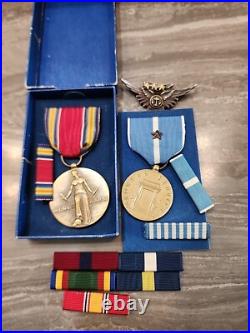
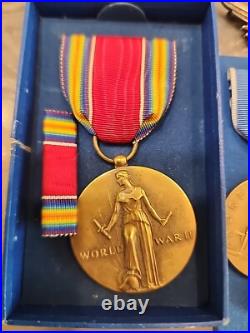
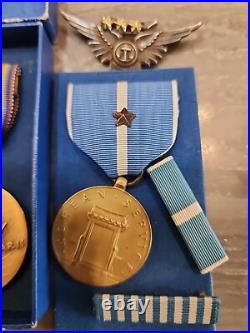
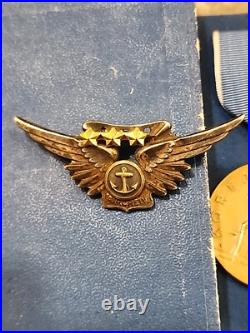
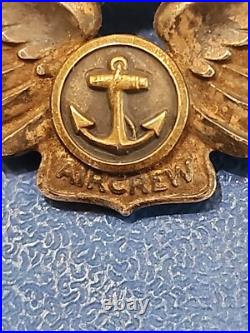
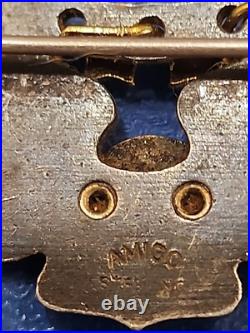
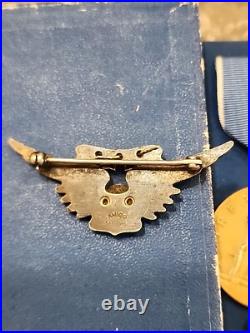
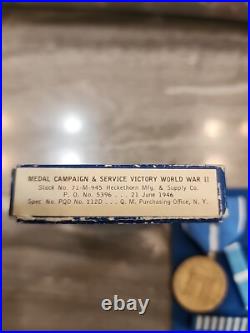
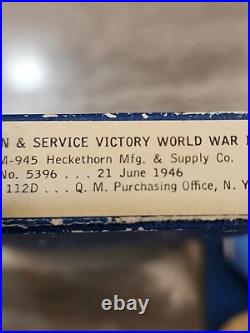
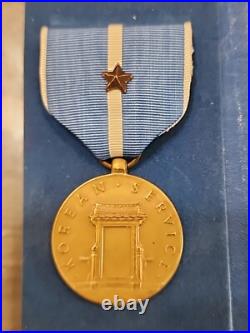
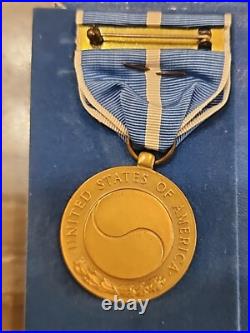
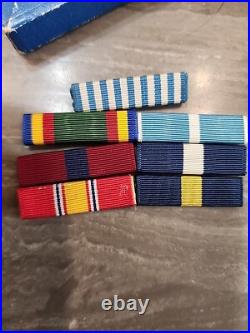
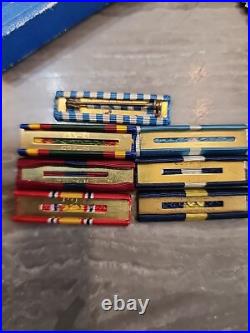
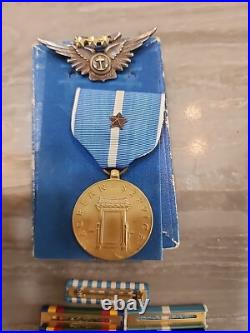

PLEASE FOLLOW OUR E BAY STORE. We do not want your feed back. We want your repeat business. We get by having best prices on the net. In original box, Dated 21 June 1946.
Note: Gold stars are add to COMBAT WINGS post 1970, wings are made 1950s. During World War II, numerous fleet requests occurred to recognize the work of the enlisted aircrew members flying in combat, the result was the creation of the Air Crew Insignia on 18 May 1943. While primarily an enlisted insignia, officers were eligible if they met the same criteria of Bureau of Naval Personnel (BUPERS) Circular Letter 90-43. The design was essentially the same as today's insignia except all pewter silver with no gold. A subsequent BUPERS Circular Letter 395-44 dated 30 Dec 1944, changed the design to the same as today with the modification of the gold center disc. In 1958, the insignia was redesignated the. In 1978, the Navy removed the insignia as authorized wear and then in 1994, the Marine Corps reestablished the insignia as it is known today as the Marine Combat Aircrew Badge. It is a decoration of the. Which is awarded to those enlisted personnel who have served as aircrew members on board combat flights. For those who have participated in actual combat missions, gold service stars. Are worn pinned to the top of the decoration. MCO 1000.6G Para 3310.4. Upon earning more than three gold stars, silver stars are awarded in recognition of three gold stars, meaning three silver equates to nine gold plus the initial award of the combat aircrew device. MCO P1020 Para 4002.1F. The Marine Combat Aircrew Badge can be issued to service members of both the Marine Corps and United States Navy (while serving in a Marine Corps aviation squadron). Current regulations require a set number of combat'points' to be earned before wear is authorized.It is not authorized to wear both the Combat Aircrew and Naval Aircrew pins at the same time. If an individual service member has been awarded both badges, they may decide which pin to wear on their uniform. The Korean Service Medal (KSM) was a military award for service in the United States Armed Forces and was established November 8, 1950, by executive order of President Harry Truman. The Korean Service Medal is the primary US military award for service or participation in operations in the Korean area during the Korean War between June 27, 1950, and July 27, 1954.
The United States Department of Defense declared thirteen official campaigns of the Korean War, all of which are annotated by service stars on the Korean Service Medal. Some campaigns apply to all branches of the US military, while others are branch specific. The Korean Service Medal is authorized a 3/16 bronze or silver (indicates five campaigns) service star to denote participation in any of the following campaigns. North Korean Aggression (USMC, Navy): June 27 to November 2, 1950.United Nations Defensive (Army, USAF): June 27 to September 15, 1950[4]. Inchon Landing (USMC, Navy): September 13 to 17, 1950. United Nations Offensive (Army, USAF): September 16 to November 2, 1950[4]. Chinese Communist Forces Intervention (Army, USAF): November 3, 1950, to January 24, 1951[4].
Communist China Aggression (USMC, Navy): November 3, 1950, to January 24, 1951. First United Nations Counteroffensive (USMC, Army, Navy, USAF): January 25 to April 21, 1951[4]. Chinese Communist Forces Spring Offensive (USMC, Army, Navy, USAF): April 22 to July 8, 1951[4]. United Nations Summer-Fall Offensive (USMC, Army, Navy, USAF): July 9 to November 27, 1951[4]. Second Korean Winter (USMC, Army, Navy, USAF): November 28, 1951, to April 30, 1952[4].
Korean Defense Summer-Fall, 1952 (USMC, Army, Navy, USAF): May 1 to November 30, 1952[4]. Third Korean Winter (USMC, Army, Navy, USAF): December 1, 1952, to April 30, 1953[4].
Korea, Summer 1953 (USMC, Army, Navy, USAF): May 1 to July 27, 1953[4]. An arrowhead device is authorized for US Army or Air Force personnel to denote participation in each of the following:[5].Airborne attacks on Sukch'on-Such'on and Munsan-Ni. Fleet Marine Force combat operation insignia. The Fleet Marine Force Combat Operation Insignia is authorized for US Navy personnel who served with the Marine Corps at any time during the Korean War.
Although the Korean War Armistice ended combat operations in Korea on 27 July 1953, the Korean Service Medal was issued until June 1954 due to the tense nature of the occupation and garrison duty immediately after the armistice, as well as the high possibility of a renewed attack by North Korea. After 1954, the Korean Service Medal was no longer issued although the Armed Forces Expeditionary Medal was authorized for Korean area service between October 1, 1966, to June 30, 1974. As of 2004, a new medal known as the Korea Defense Service Medal was authorized for members of the armed forces who served in the defense of the Republic of Korea from July 28, 1954, to a date to be determined. The KSM was designed by the Army Heraldic Section. The color scheme of the ribbon is derived from the Flag of the United Nations, as it was under the auspices of the United Nations (United Nations Security Council Resolution 82) that the war was conducted. The medal itself features a "Korean gateway, " most likely an iljumun, on the front, and a taegeuk on the reverse. The United Nations Service Medal for Korea was usually issued alongside the Korean Service Medal. Beginning in 1999, the Republic of Korea War Service Medal was also awarded to United States service members who received the Korean Service Medal. The Republic of Korea Presidential Unit Citation is retroactively authorized to any United States Army veteran who served in Korea during the War.