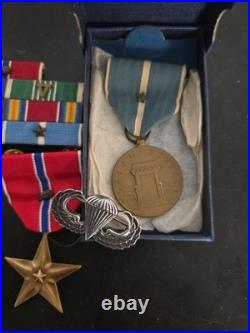
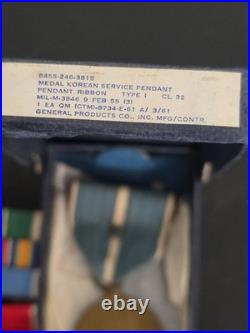
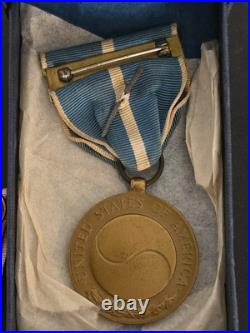
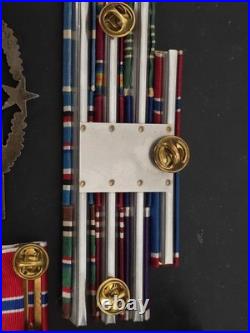
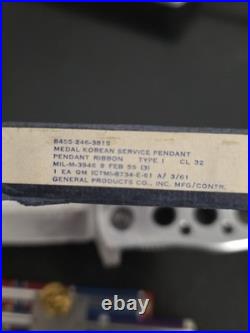
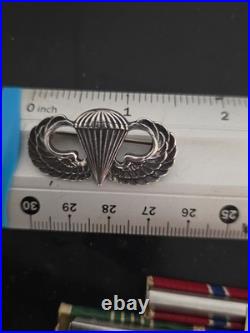
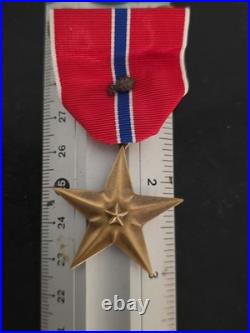
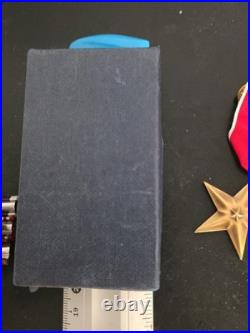
Korean War Medals Dated Box 1955-Both Sterling CIB -Jump Wings -11-RIbbons Rack
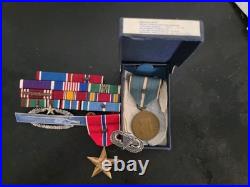
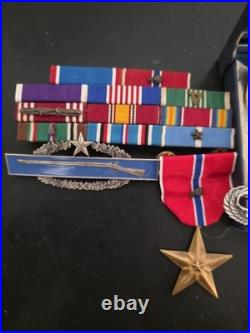
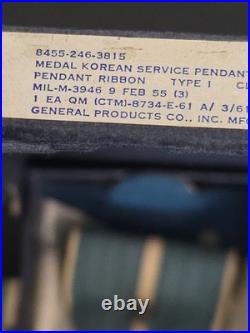
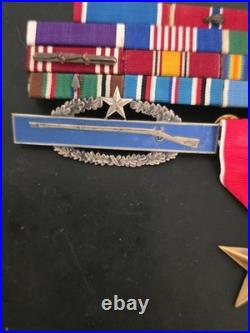
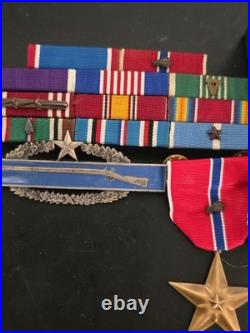
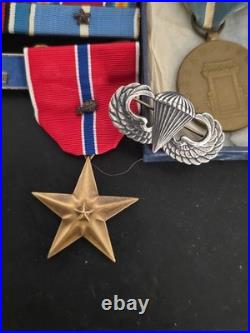
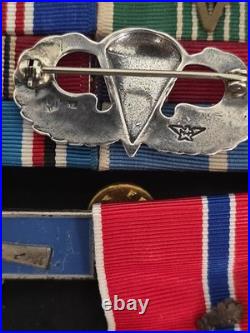
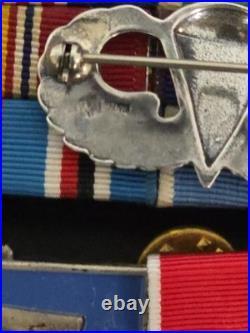
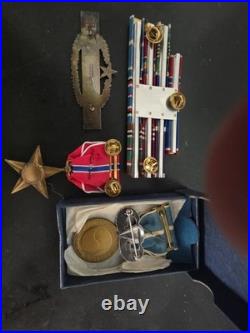
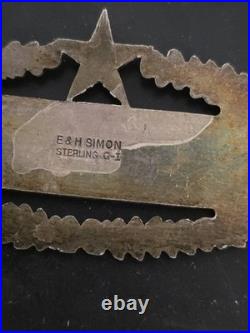
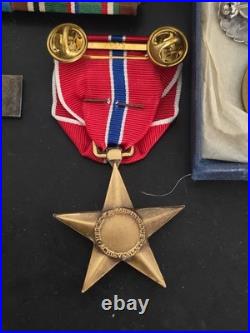
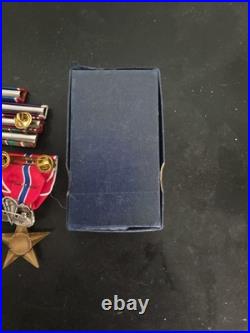
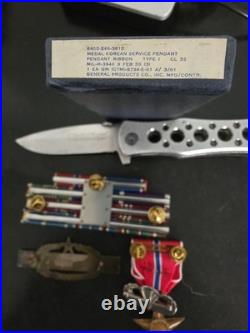
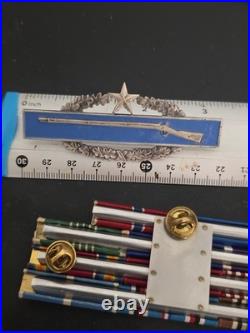
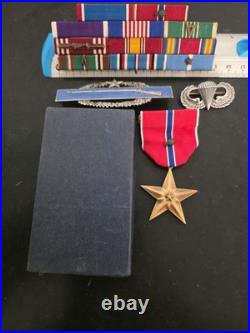

PLEASE FOLLOW OUR E BAY STORE. We want your repeat business. We get by having best prices on the net. On 8 February 1952, the Army approved the addition of stars to the CIB indicating the soldier's having fought in more than one war. The first was the second-award CIB recognizing Korean War.
Combat operations; in that time, the U. Army's Institute of Heraldry. Also had created eighth-award CIB designs. The second- through fourth-award CIB awards were indicated with silver five-point stars, one to three stars centered, at badge's top, between the tips of the oak-leaf wreath; the fifth- through eighth-awards of the CIB were indicated with gold stars. However, Army Regulation 600-8-22 (Military Awards) only authorizes up to three awards of the CIB.
There are four periods for which an award of the badge can be made. World War II (7 December 1941 to 3 September 1945). Korean War (27 June 1950 to 27 July 1953).
Vietnam War and other Cold War era actions (2 March 1961 to 10 March 1995). War on Terror (18 September 2001 to a date to be determined). Currently, the Combat Infantryman Badge is worn. Inch (6.4 mm) above the service ribbons above the left-breast pocket of the Class-A uniform coat and of the other uniforms with which the CIB is authorized.
As of June 2011, the badge and its sew-on equivalent may be worn on the Army Combat Uniform (ACU). Special Skill Group 1 Badge. Army infantry or special forces officers (SSI 11 or 18) in the grade of colonel or below, Army enlisted soldiers and warrant officers with an infantry or Special Forces military occupational specialty.
Also commonly referred to as. Some services, such as the Marine Corps, officially refer to it as an insignia instead of a badge. That do not award the Parachutist Badge, but their members are authorized to receive the Parachutist Badges of other services in accordance with their prescribed requirements.
The DoD military services are all awarded the same Military Parachutist Badge. Issue the same Senior and Master Parachutist Badges while the. Issue the Navy and Marine Corps Parachutist Insignia to advanced parachutists. The majority of the services earn their Military Parachutist Badge through the.
The Army's Parachutist Badge is awarded to all military personnel of any service who complete the US Army Basic Airborne Course. It signifies that the soldier is a trained military parachutist. And is qualified to participate in airborne operations.
The badge and its sew-on equivalent may be worn on the Army Combat Uniform (ACU). Original sketch for the U. Army Parachutist Badge, by William P. The original Army Parachutist Badge was designed in 1941 by Captain.
And approved by the Department of War in March of that year. The Parachutist Badge replaced the "Parachutist Patch" which had previously been worn as a large patch on the side of a paratrooper's garrison cap. LTG Yarborough also designed the Senior and Master Parachutist Badges and the addition of stars to portray the number of combat jumps.
The airborne background trimming that is worn behind the badge of those assigned to airborne units is also a contribution of Yarborough. The Senior and Master Parachutist Badges were authorized in 1949. Service within territorial limits or service that directly supported the UN's military efforts in defense of South Korea between 1950 and 1954. Obverse: On a bronze medal, 1-1/4 inch in diameter, a Korean gateway, encircled by the inscription "KOREAN SERVICE". Reverse: On the reverse is the Korean "taegeuk" symbol taken from the center of the South Korean national flag with the inscription "UNITED STATES OF AMERICA" and a spray of oak and laurel encircling the design. Ribbon: The ribbon is 1-3/8 inches wide and consists of the following stripes: 1/32 inch White; 19/32 inch Bluebird; center 1/8 inch White; 19/32 inch Bluebird; and 1/32 inch White.The US Department of Defense. Military service during the Korean War. November 8, 1950, as amended. 1950 (retroactive to June 27, 1950). The United States Department of Defense.
Declared thirteen official campaigns of the Korean War, all of which are annotated by service stars. On the Korean Service Medal. Some campaigns apply to all branches of the US military, while others are branch specific.The Korean Service Medal is authorized a 3/16 bronze or silver (indicates five campaigns) service star to denote participation in any of the following campaigns. North Korean Aggression (USMC, Navy): June 27 to November 2, 1950. United Nations Defensive (Army, USAF): June 27 to September 15, 1950. Inchon Landing (USMC, Navy): September 13 to 17, 1950.
United Nations Offensive (Army, USAF): September 16 to November 2, 1950. Chinese Communist Forces Intervention (Army, USAF): November 3, 1950, to January 24, 1951. Communist China Aggression (USMC, Navy): November 3, 1950, to January 24, 1951.
First United Nations Counteroffensive (USMC, Army, Navy, USAF): January 25 to April 21, 1951. Chinese Communist Forces Spring Offensive (USMC, Army, Navy, USAF): April 22 to July 8, 1951. United Nations Summer-Fall Offensive (USMC, Army, Navy, USAF): July 9 to November 27, 1951. Second Korean Winter (USMC, Army, Navy, USAF): November 28, 1951, to April 30, 1952. Korean Defense Summer-Fall, 1952 (USMC, Army, Navy, USAF): May 1 to November 30, 1952.
Third Korean Winter (USMC, Army, Navy, USAF): December 1, 1952, to April 30, 1953. Korea, Summer 1953 (USMC, Army, Navy, USAF): May 1 to July 27, 1953.
PLEASE SEE STORE WW1- WW2 MEDALS -STERLING SILVER BADGES - RARE COINS PCGS GRADED /RARE GRADED CURRENCY.