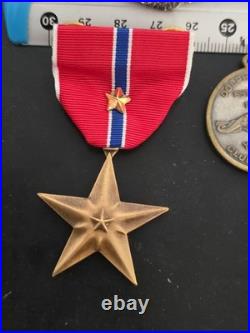
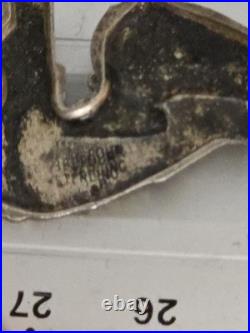
Korea War Navy Sterling Silver Sub Badge + Brnze Star Medal + 1953 Enlisted Club
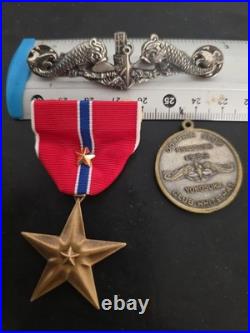
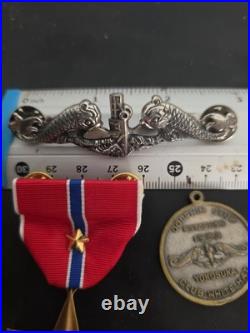
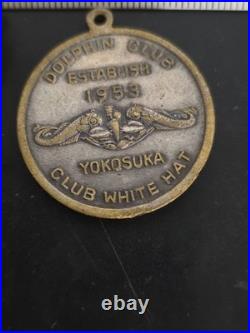
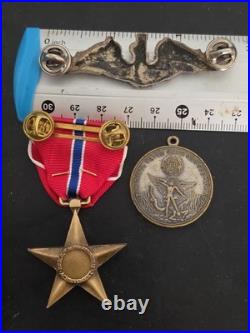
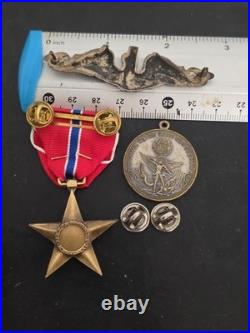
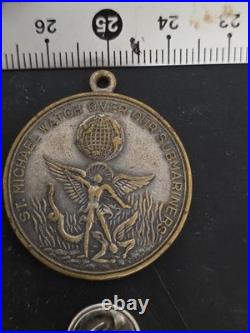
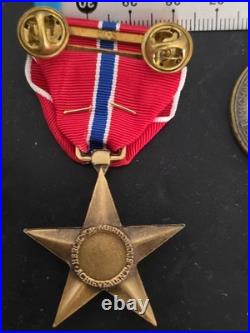

PLEASE FOLLOW OUR E BAY STORE. We want your repeat business. We get by having best prices on the net. US Navy Dolphin Club / Club White Hat 1953 Yokosuka Japan "St Michael Watch Over Our Submarines".
On 30 August 1945, Vice Admiral Michitaro Totsuka. Last Japanese commander of the Yokosuka Naval District, surrendered his command to Rear Admiral Robert Carney. And the base was peacefully occupied by U.
Of the 6th Marine Division. Commander Fleet Activities (COMFLEACT) Yokosuka was created shortly after the occupation in 1945. As the Base became organized, the shipyard was deactivated and much of the equipment was sent to other countries as part of reparations.
Later Naval Hospital Yokosuka Japan. And the Supply Department was organized to provide support to the fleet and shore-based activities. The Public Works Department was established. Yokosuka Submarine Base was founded in September 1945.In May 1946, the Marines at Yokosuka were redesignated Marine Barracks, U. With the onset of the Korean War. On 25 June 1950, Yokosuka Navy Base suddenly became very important and extremely busy. Still an occupying power in Japan, turned its full efforts to the support of South Korea.
The Navy Dispensary was enlarged and expanded and was commissioned a U. The Naval Communications Facility, Yokosuka, was commissioned in January 1951. Seventh Fleet during both the Korean War. In March 1952, the geographical boundaries of Naval Forces Far East. Were changed to exclude the Philippines, Marianas. In December 1952, the headquarters were shifted from Tokyo to Yokosuka.The expanded Supply Department of Fleet Activities became Naval Supply Depot, Yokosuka in August 1952. In 1960, the Naval Communications Facility was redesignated U. In 1952, US occupation of Japan formally ended and Japanese rearmament commenced, with its naval forces formally organized as Japan Maritime Self Defense Force.
Some parts of the former Yokosuka Naval District were ceded back to house a new base for JMSDF, now known as JMSDF Yokosuka Naval Base. The insignia of the U. Submarine service is a submarine flanked by two dolphins.
Dolphins, attendants to the Poseidon, Greek god of the sea and patron deity to sailors, is sometimes referred to as the sailor's friend. They were also chosen to represent the Submarine Service because of the characteristic way in which dolphins dive and surface. On 13 June 1923, Captain E.King, Commander, Submarine Division Three later Fleet Admiral and Commander in Chief, U. Fleet, during WW II, suggested to the Secretary of the Navy via the Bureau of Navigation (now known as BuPers) that a distinguishing device for qualified submariners be adopted.
He submitted a pen-and-ink sketch of his own showing a shield mounted on the beam ends of a submarine, with dolphins forward of, and abaft, the conning tower. The suggestion was strongly endorsed by Commander Submarine Division Atlantic. Over the next several months the Bureau of Navigation solicited additional designs from several sources. Some combined a submarine with a shark motif. Others showed submarines and dolphins, and still others used a shield design.
A Philadelphia firm, Bailey, Banks & Biddle (BB&B), which had done work in the field of Naval crests, was approached by the Bureau of Navigation with the request that it design a suitable badge. Two designs were submitted by the firm, one of which was to be used for the U. Naval Academy's 1926 class crest, which had been designed by under-classman William C. These two designs were combined into a single concept. It was a starboard angle on the bow view of an "O" class submarine, proceeding on the surface, with bow planes rigged for diving, flanked by dolphins in a horizontal position with their heads resting on the upper edge of the bow planes.On 20 March 1924, the Chief of the Bureau of Navigation recommended to the Secretary of the Navy that the design be adopted. The recommendation was accepted by Theodore Roosevelt, Jr.
Acting Secretary of the Navy. His acceptance is dated March 1924. Today the original BB&B design is used by many manufactures without modification, while others choose to take some artistic license, especially in updating the class of submarine depicted. The submarine insignia was to be worn at all times by officers and men qualified in submarine duty attached to submarine units or organizations, ashore and afloat, and not to be worn when not attached.
The officers' insignia was a gold metal pin (gold plating over "sterling" silver, or bronze), worn centered above the left breast pocket and above the ribbons and medals. Enlisted men wore the insignia, embroidered in silk, white silk for blue clothing and blue silk for white clothing. This was sewn on the outside of the right sleeve, midway between the wrist and elbow. The device was two and three-quarters inches long. In 1943, the Uniform Regulations were modified to provide that: Enlisted men, who are qualified and subsequently promoted to commissioned or warrant ranks, may wear enlisted submarine insignia on the left breast until they qualify as submarine officers, at which time this insignia would be replaced by the officers' submarine pin. In mid-1947, the embroidered device shifted from the right sleeve of the enlisted men's jumper to above the left breast pocket. On 21 September 1950, a change to the Uniform Regulations authorized officers the option of either a gold bullion embroidered sew-on insignia, or gold plated pin-on insignia. Enlisted submariners were given the option of either a silver bullion embroidered sew-on insignia, or a "sterling" silver (or silver plated), metal pin-on insignia for the dress uniform. This was in addition to the silk embroidered insignia sewn on the undress uniform. The Bronze Star Medal (BSM) is a United States Armed Forces decoration. Awarded to members of the United States Armed Forces. For either heroic achievement, heroic service, meritorious achievement, or meritorious service in a combat zone. When the medal is awarded by the Army. For acts of valor in combat, the "V" device. Is authorized for wear on the medal.When the medal is awarded by the Navy. For acts of valor or meritorious service in combat, the Combat "V". "Heroic or meritorious achievement or service". Department of the Air Force.
Army, Air Force, and Space Force - "V" device. Navy, Marine Corps, and Coast Guard - Combat "V". 4 February 1944 superseded by E. 4 February 1944 (retroactive through 7 December 1941). PLEASE SEE STORE WW1- WW2 MEDALS -STERLING SILVER BADGES - RARE COINS PCGS GRADED /RARE GRADED CURRENCY.